What to know about using abortion pills and some legislative updates on accessing this form of care.
By Sierra R., ARC-Southeast Caller Engagement Coordinator
By now, you’ve probably heard of “abortion pills” and “medication abortion,” and maybe you’ve even heard the term “self-managed abortion” (SMA) in the news. As the political and legal environments continue to evolve, we want to reiterate that one of the two most common abortion medications, Mifepristone, is still available and effective.
Despite being challenged in the courts, Medication abortion is also still available by mail in all 50 states.
Just last year, the 5th Circuit Court of Appeals (which covers Texas, Mississippi and Louisiana) issued a ruling aiming to restrict access to Mifepristone. You can check out our blog post on that ruling here. Meanwhile in a case from earlier this year, The Alliance for Hippocratic Medicine v. FDA, the U.S. Supreme Court that anti-abortion plaintiffs suing the FDA did not have standing to bring the case.
In the Alliance case, the Supreme Court of the United States decided that the Texas court cannot block the initial FDA approval of Mifepristone, nor roll back the more recent measures the FDA has taken to increase access to the medication further. This is a pretty big deal because this could have heavily restricted access to one of the most commonly used medications for abortion across the United States, even in places that haven’t restricted abortion procedures, as well as miscarriage care. The Supreme Court heard oral arguments for this case in March. You can listen to those here.
Despite SCOTUS’ ruling, state legislatures haven’t taken a break from targeting abortion care either. As of Oct. 1, Louisiana classifies the two abortion pills, mifepristone and misoprostol, as controlled substances, like opioids and other medications with addictive properties. But let’s be clear: abortion medication is still available in all 50 states. Even in states that have entirely banned abortions, individuals still have access to online resources that can help order abortion medication and doctors in states with shield laws can still ship abortion medication. This law is meant to scare folks into not ordering online or obtaining abortion pills via telemedicine. Louisiana already has laws in place that ban abortion entirely, with very few exceptions. Additionally, state law already restricted abortion medication, too. This really highlights how baseless and politically motivated the controlled substance law is.
As we continue to see abortion medication being challenged across the U.S., an understanding of what these medications are and how to use them is increasingly crucial. So, we wanted to offer a 101 on what abortion pills are and what they aren’t.
A Brief History of Self-Managed Abortion
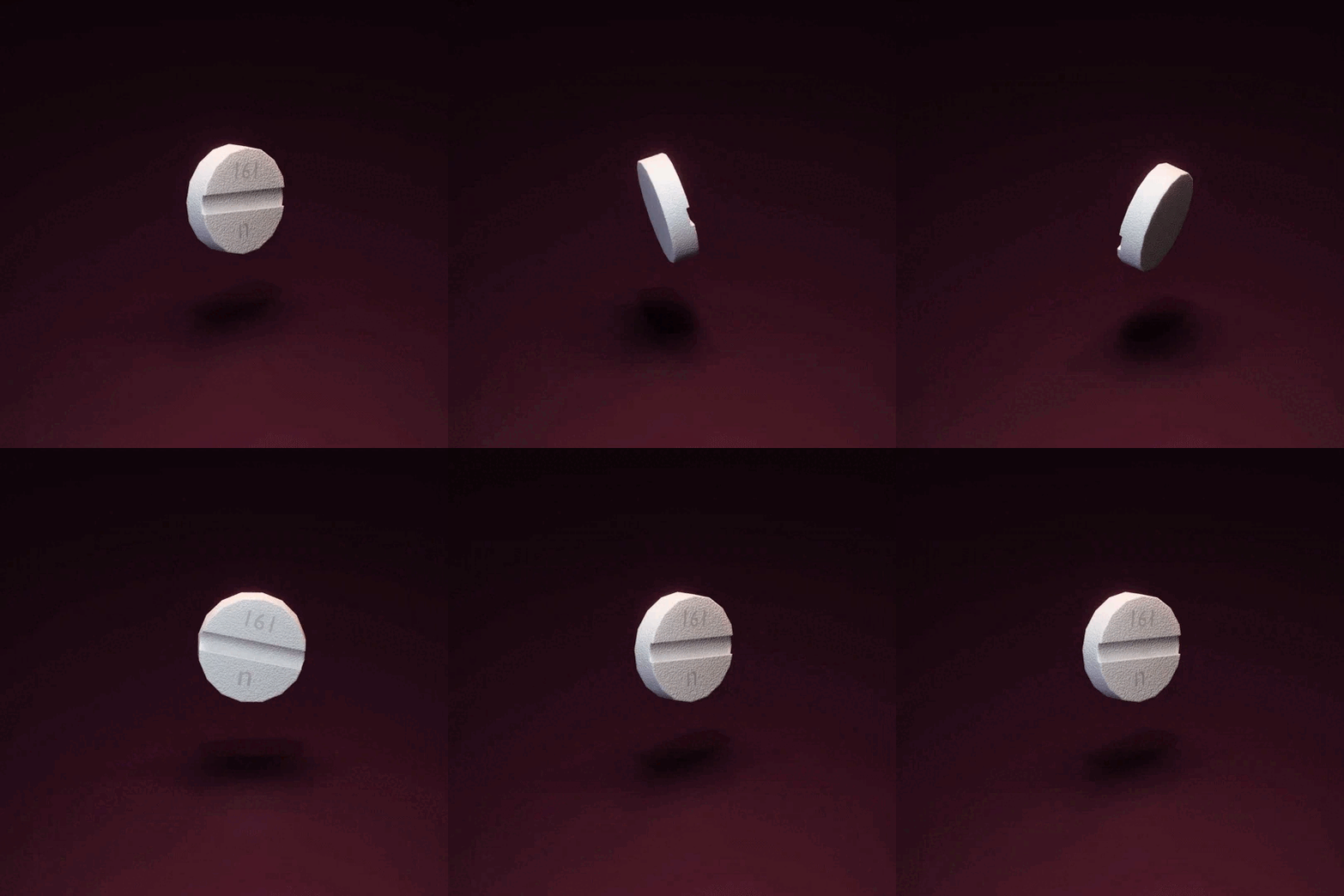
Generally, when you hear the term “abortion pills,” the medications that are being referred to are misoprostol and mifepristone. Most of the time, people use a combination of both pills to have a medication abortion. There is a misoprostol-only regime as well, but it requires more doses of the medication, which is why it’s more common to use both pills. More on that later, but this is important to remember, especially since mifepristone is the medication named in The Alliance for Hippocratic Medicine v. FDA (2024) SCOTUS case previously mentioned.
Misoprostol is an inexpensive medication that someone can use to treat a number of medical conditions like stomach ulcers, but it can also be used to induce labor, which is why it is used in abortion care (and to treat miscarriages). We can thank Brazilian women for that knowledge. In some countries, including Brazil, misoprostol is sold over the counter because of its safety and multiple medical uses. Women noticed the warnings on the label, stating the medication could cause a miscarriage if used by a pregnant person and began using the medication to terminate unexpected pregnancies. Later, an official protocol using misoprostol to terminate pregnancies was developed. Misoprostol is the safest and most effective during the first 12 weeks of pregnancy.
Mifepristone is a safe and effective medication used in combination with misoprostol to terminate pregnancy. This pill assists the body in stopping the production of progesterone, a hormone necessary for a pregnancy to continue. Mifepristone is also a vital medication for miscarriage treatment, mainly when a pregnancy is further along.
Almost 24 years ago, the FDA approved the use of mifepristone and misoprostol together to terminate pregnancy effectively. When used as instructed, they are up to 99% effective in terminating pregnancy!
Abortion Pills vs. Plan B
Understanding what “abortion pills” are and how they work is essential because it is crucial we know what they aren’t. Mifepristone and misoprostol are not oral contraceptives, meaning they aren’t used to prevent pregnancy, like birth control pills or emergency contraceptive pills (a.k.a. “morning after-pills”). We know abortion medication is being targeted, and it’s a lot easier to come after things like birth control and emergency contraceptives when people are confused about these methods and medications. We know this because just several months after the Dobbs decision, anti-abortion proponents came after Plan B One-Step, a widely known emergency contraceptive pill. This prompted the FDA to conduct a scientific review of evidence. Subsequently, the FDA updated the labeling on Plan B One-Step packaging and information leaflets to clearly state the medication’s mechanism of action (i.e., how a medication works), citing no consistent scientific evidence supporting the notion that the medication impacts fertilization or implantation.
This all means, in short, Plan B One-Step does not impact an existing pregnancy and, therefore, is not an abortifacient. However, an alarming number of people confuse emergency contraceptives with abortion medication. This can definitely be a bit confusing, especially with so much misinformation and disinformation out there, so let’s break it down even more. Let’s be clear, though: emergency contraception is available and legal in all 50 states. Depending on what kind of emergency contraception you’re looking for, you may need a prescription for a pill like Ella, but any person of any age can purchase Plan B One-Step, with no prescription or ID required.
Ovulation, fertilization, and implantation are all steps in the cycle someone’s body goes through for them to become pregnant. Ovulation happens first and is a part of all menstrual cycles. When someone is ovulating, it becomes possible for eggs to be fertilized by sperm. Then, it takes some time for the fertilized egg to make its way to the uterus. Implantation occurs once the fertilized egg successfully attaches to the uterus. It’s certainly more complex than that, and many more things are going on in the body during this process, too, but after the entire process is complete, a person is pregnant.
Plan B One-Step works by impacting (inhibiting or delaying) ovulation, which is why emergency contraceptive pills are more effective the sooner you take them after unprotected sex. Ovulation happens before fertilization and well before implantation, meaning your body has time to prevent an egg from being fertilized and implanted, and emergency contraceptives can assist! Mifepristone and misoprostol are used to terminate a pregnancy, which happens after implantation. For more on this, check out our zine on emergency contraception!
About Mifepristone and Misoprostol
Now that we know Plan B doesn’t impact an existing pregnancy let’s get back to abortion pills and using those medications. Remember, we’re just making information available here; this is not medical advice, and it’s best to consult a trained medical professional before using any medication. The Miscarriage and Abortion Hotline can (confidentially) connect you with a trained professional if you don’t have someone you can talk to.
Like any other medication, mifepristone and misoprostol are effective if taken correctly. If someone gets abortion pills from a doctor or other medical professional, they should instruct someone on how to use these medications. However, there are numerous reasons someone may choose to self-manage their abortion. This means a person is terminating their pregnancy outside of the formal medical system. Self-managing an abortion doesn’t just happen with abortion medication (e.g., herbal abortions), but for this article, we are just going to cover self-managed abortion with misoprostol and mifepristone.
According to the Guttmacher Institute, over 50% of abortions in the United States are medication abortions, and this doesn’t even include those who self-managed their abortion. There are many reasons someone may choose to use abortion medication and/or self-manage their abortion. We should remember not to shame anyone’s decision; someone may prefer to self-manage their abortion to feel safe and comfortable, and someone may choose to self-manage their abortion because they have no other option. A person should only self-manage their abortion if they have no severe illnesses/health conditions and do not have an IUD inserted (however, an IUD can be removed before use, if needed.)
Mifepristone and misoprostol have been thoroughly researched by the World Health Organization (WHO) and are deemed safe and effective in ending a pregnancy within the first 12 weeks. There are two different methods one can perform when using abortion medication: misoprostol only and a combination of mifepristone and misoprostol. For both methods to be safe and effective, a person needs first to determine the gestational age of the pregnancy. A person should take a blood or urine test to confirm their pregnancy. If pregnancy is confirmed within the formal medical system, a person should be told the gestational age of their pregnancy. If a person does not see a medical professional, they can count from the first day of their last menstrual period up to the current date to determine the gestational age of the pregnancy.
Using Misoprostol Only
Misoprostol can be used on its own to terminate a pregnancy effectively and will be almost identical to what happens during a miscarriage. NOTE: If someone needs to go to a medical facility after using the misoprostol-only method, their body will present as if they have had a miscarriage. Misoprostol causes the uterus to cramp and push out the pregnancy.
A person will need a total of 12 misoprostol tablets (200mcg/each) to end a pregnancy successfully. These pills will be taken in 3 rounds 3 hours apart, taking 4 tablets each time. In each round, the doses should be placed under the tongue and left to dissolve for at least 30 minutes (no eating or drinking during this time). After 30 minutes, a person can swallow whatever remains in their mouth and eat and drink normally (alcohol and drug use are not advised so someone can accurately monitor their body’s reaction to the medication). If this regime is followed, it is rare for a person to experience complications. Still, if, for some reason, they do need to consult with a medical professional, there is no medical test that can detect the use of misoprostol.
Using Mifepristone and Misoprostol
A person will need a total of 1 mifepristone tablet (200mg) and 4 misoprostol tablets (200 mcg/each) to terminate their pregnancy successfully.
First, a person will take one tablet of mifepristone and wait 24 hours. There will likely be NO noticeable side effects after taking mifepristone. This is NORMAL because mifepristone stops progesterone production but doesn’t actually cause the body to expel a pregnancy. After 24 hours, a person will place two misoprostol tablets between the gums and cheek on each side (four misoprostol tablets in total) and wait 30 minutes for those tablets to dissolve before swallowing, eating or drinking.
What to Expect
A person should know that it is more effective to use mifepristone AND misoprostol, but if a person only has access to misoprostol, the described protocol can be effective in terminating a pregnancy. Mifepristone alone will not produce any side effects. If a person takes misoprostol and does not experience any of the following symptoms, that indicates they did not follow the instructions correctly, the misoprostol has expired, or they have been given counterfeit misoprostol.
After taking misoprostol, a person may experience:
- – Cramps and pain. These will be more intense than “normal” period cramps, but ibuprofen can help ease the pain.
- – Nausea, vomiting, diarrhea. A person should be cautious not to vomit up the pills they have taken. If someone is prone to this, it is recommended to take anti-nausea medication as well.
- – Bleeding. Bleeding will generally start 4 – 5 hours after taking misoprostol. This is an indication that abortion is beginning. Cramping will be intense during this time as well. Bleeding is usually heavier than someone’s regular period. A person should not use more than two maxi pads in two hours during their medication abortion. If a person is bleeding more than this, they may be experiencing a complication. It is common for light bleeding/spotting to occur for several weeks after an abortion. A person can expect their menstrual period to regulate 4 – 6 weeks after their abortion.
The severity of these symptoms varies and can depend upon a pregnancy’s gestational age. An abortion occurring at 6 weeks of pregnancy versus 10 weeks of pregnancy will feel and look different.
After Care
Because the cervix remains open after an abortion, nothing should be inserted into the vagina for at least 5 days to prevent an infection from occurring (no tampons or penetrative sex). A person can get pregnant immediately after an abortion, so a person should consider a plan to prevent pregnancy if they do not want to become pregnant again.
A person should also take a pregnancy test several weeks (2 – 3 weeks at least) after their abortion to confirm it was complete and successful. If using a urine test, remember that pregnancy hormones can remain in the body for weeks after an abortion and could cause a false positive. If a person confirms or believes their abortion was not successful or complete, they can use abortion pills again 72 hours later. The most accurate way to confirm you are not pregnant and had a complete abortion is to have an ultrasound.
Sometimes, a person may have an incomplete abortion. If a person has very intense pain, bleeding that goes on for longer than a few hours, and/or a fever for more than one day, they should seek medical help to avoid serious complications. A person does NOT need to say they used abortion pills if that puts them at any kind of risk; they can say they are experiencing a miscarriage and will receive the same care.
If possible, a person should have someone there to support them during and after their abortion. It is important they are kind to their body, get enough sleep, and nourish themselves! This process can be a lot on one’s body and mind.
Care about access to self-managed abortion in the Southeast? Donate to ARC-Southeast to support our efforts to make SMA accessible.
Additional Resources
– Abortion pills are available online in all 50 states.
– Text and Call Medical Support: M & A Hotline
– Current Abortion Laws State by State: Guttmacher Institute
– Digital Security Matters! Check out the Digital Defense Fund.