By Sofia T. and Musa S.
The South is the common denominator. That’s why we center Southern power as one of our core values.
With a history that is inextricably linked to slavery, the Southeast is not just the site of the most abortion bans: it is also home to the highest incarceration rates, the most low-wage workers, the highest healthcare disparities, the most domestic military bases, the highest maternal mortality rates, and the lowest average life expectancy in the U.S..
When we put abortion bans into this full context, we see that anti-abortion bans and stigma are not random, but rather deeply tied to the ongoing legacy of chattel slavery, structural racism, and forcing the reproduction of the most oppressed workers in the nation.
Data is incredibly powerful when telling stories. Data helps us tell stories of injustice, resilience, and the interconnectedness of both the oppression affecting our communities, and all those who work towards liberation from this oppression. On one hand we have anecdotes, experiences, and ‘qualitative’ data. On the other hand we have statistics, facts, studies, and ‘quantitative’ data. Both are important and necessary to tell the full story of abortion in the South.
The maps that accompany this post reveal the disparities in reproductive healthcare access that oppressed, colonized communities face in the Southeast, and how these issues are not just limited to reproductive healthcare – they are reflections of broader systemic injustice rooted in white supremacy. By illuminating these realities, we can better understand the systemic issues at the root of the disparities felt across the Southeast and collectively work to dismantle these structures.
The Historical Context Of The Southeast
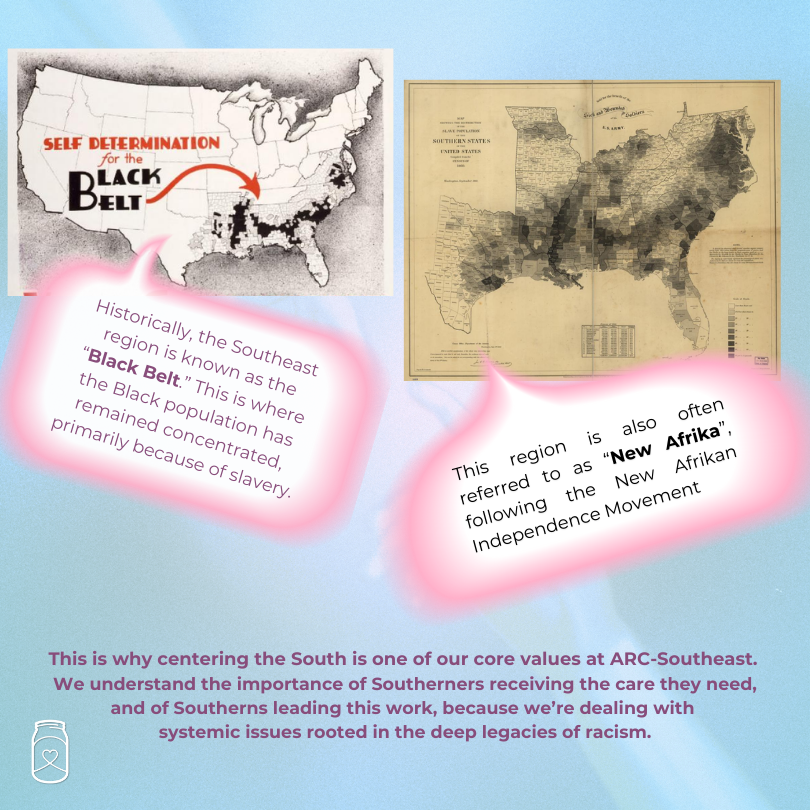
The history of the Southeast is inseparable from the history of Black struggle and resilience, beginning with the forced migration (kidnapping) and enslavement of Africans. During slavery, the bodies of African peoples were commodified, and reproduction was weaponized to fuel the institution of slave labor. Even after emancipation, Southern Black communities faced systemic racism, violence, and economic deprivation that continues to this day. The Southeast’s ongoing struggle with abortion bans and reproductive restrictions is a direct legacy of this exploitation, which has long denied Black people control over their reproductive choices.
Movements like the Republic of New Afrika (RNA) in the 1960s and the Black Belt Thesis as early as 1894 emerged from the recognition of this history, and both are crucial to understanding the movement for Black autonomy and self-determination in the South. The RNA called for a Black nation in the Black Belt South, where Black populations and labor remain concentrated, envisioning a future where Black communities could exercise political and economic power over their own lives and land. The Black Belt Thesis, similarly, is a political thesis that Black people in the Southeast constituted a distinct national identity, with unique shared population, culture, spirituality, dialects, and history deserving of self-determination. Both frameworks highlight how the control of Black bodies and Black futures is not merely a relic of slavery, but an ongoing struggle so long as self-determination is lacking.
These movements offer a framework for understanding how abortion restrictions in the Southeast intersect with the broader fight for Black liberation. The high rates of maternal mortality, healthcare disparity, and restricted reproductive rights affecting Black communities today are not concentrated in the South by happenstance. It reflects the legacy of control and exploitation: exploited Black service workers in the South continue to make up an extremely significant population for the profits of many large corporations, and are the bulk of the incarcerated population. For Black Southerners, reproductive justice is intertwined with the right to self-determination and autonomy, making the Southeast a central battleground in the ongoing struggle for liberation.
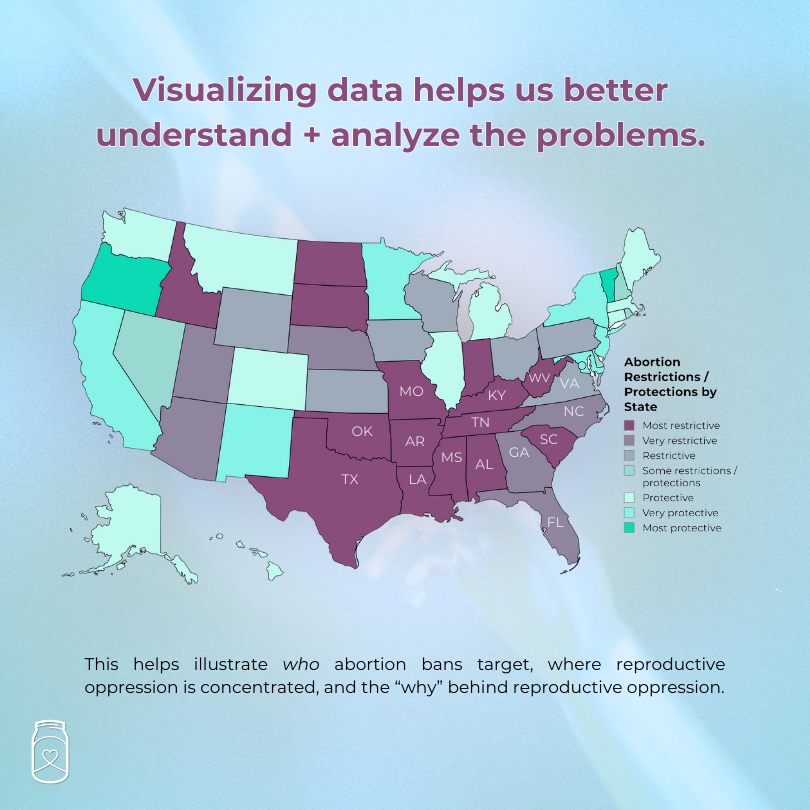
This map highlights how the states with the most stringent abortion restrictions are predominantly concentrated in the South, creating formidable barriers to accessing care. In fact, many areas in the South are considered ‘abortion deserts’ – cities where people must travel more than 100 miles to reach a clinic. This not only imposes significant logistical challenges but also amplifies the financial and emotional burdens on those already facing difficult circumstances who may not be able to afford or arrange for transportation, lodging, time off work, disability accommodations, childcare, or any other needs related to traveling to an abortion clinic.
Fun fact: in 1900 roughly 90% of Black people in the US lived in the South; in 2022, roughly 60% of Black people still live in the South. This is why historically, Black Southern movements like the Republic of New Afrika (RNA) and the Student Nonviolent Coordinating Committee (SNCC) have been so keen to connect the struggles of the South to international struggles. Africans are in the South in high numbers because of colonialism and imperialist expansion, and therefore deeply connect with struggles taking place across the world.
Disparities in Access: The Intersection of Race and Reproductive Healthcare
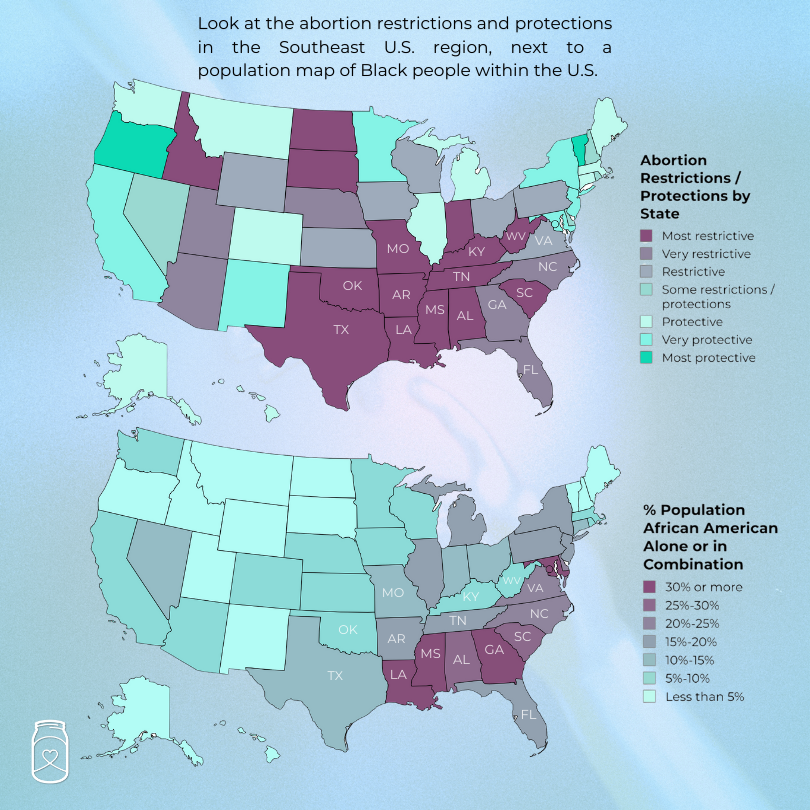
Our next set of maps juxtaposes the restrictive abortion laws in the South with the nationwide distribution of Black populations, revealing that the areas with the most restrictive abortion laws also have the highest concentration of Black populations. This correlation underscores a critical truth: abortion restrictions disproportionately harm and target Black people.
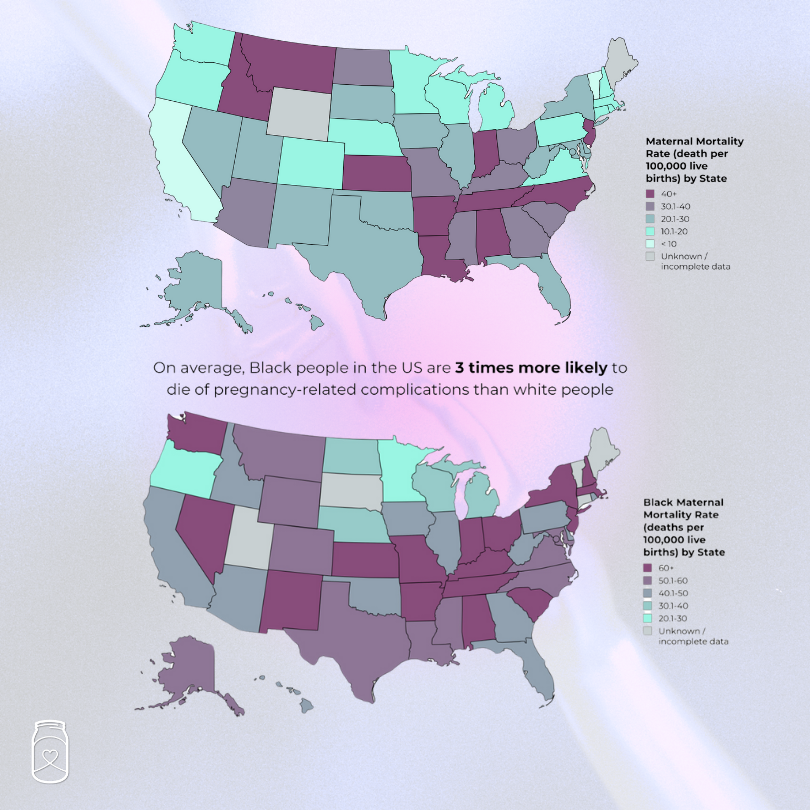
Black people in the US are already three times more likely to die in pregnancy or delivery than any other race, and this disparity is even higher for Black people in the South. The lack of access to abortion services exacerbates existing health inequities and contributes to an overall shortage of reproductive healthcare, which can have fatal consequences.
This is why Southern Synergy and building Southern collective power iis one of our core values at ARC-Southeast. We understand the importance of Southerners receiving the care they need, and of Southerns leading this work, because we know its impact and the deep legacies of racism we’re dealing with.
Understanding Reproductive Justice
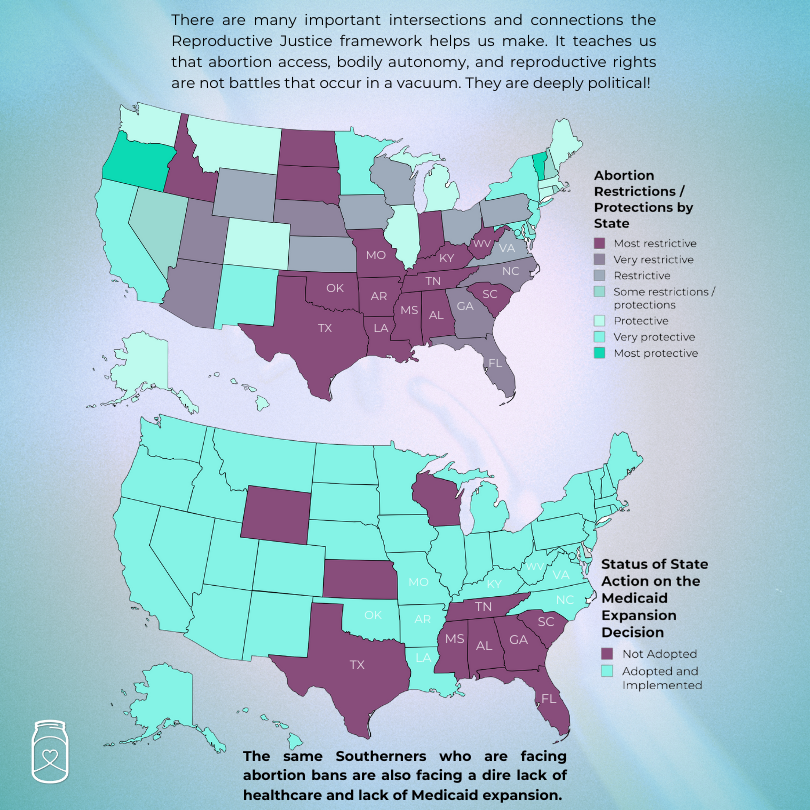
At the heart of our mission lies the Reproductive Justice framework, which connects reproductive rights and abortion access to broader social injustices including but not limited to economic disparity, racial oppression, incarceration, and systemic state violence. Reproductive Justice advocates for the right to have children, not have children, and to parent in safe and supportive environments. By addressing the interconnected injustices that impact these rights, we can work toward a future where all communities have the resources they need to thrive.
Reproductive Justice as a framework also means analyzing and understanding the primary contradictions of an issue, and striking the root causes of reproductive issues. This is why we often say that abortion funds like ARC-Southeast are “fulfilling a role that the state should be doing,” “filling the gaps created by the state,” and “providing people with their basic human rights that they deserve.” In other words, we understand that the state and elected officials have not only failed our Southern communities, but are actively abandoning them.
The above map illustrates that most states that have opted not to expand Medicaid under the Affordable Care Act are in the South. This decision leaves millions without access to affordable healthcare, further targeting and harming Black, Indigenous, immigrant, and poor communities. The lack of Medicaid expansion exacerbates the challenges faced by those in need of reproductive healthcare services, contributing to cycles of inequity, and showing how the state has abandoned their basic role of taking care of people through support and services.
Incarceration, Low Wages, and Abortion Access: A Converging Crisis
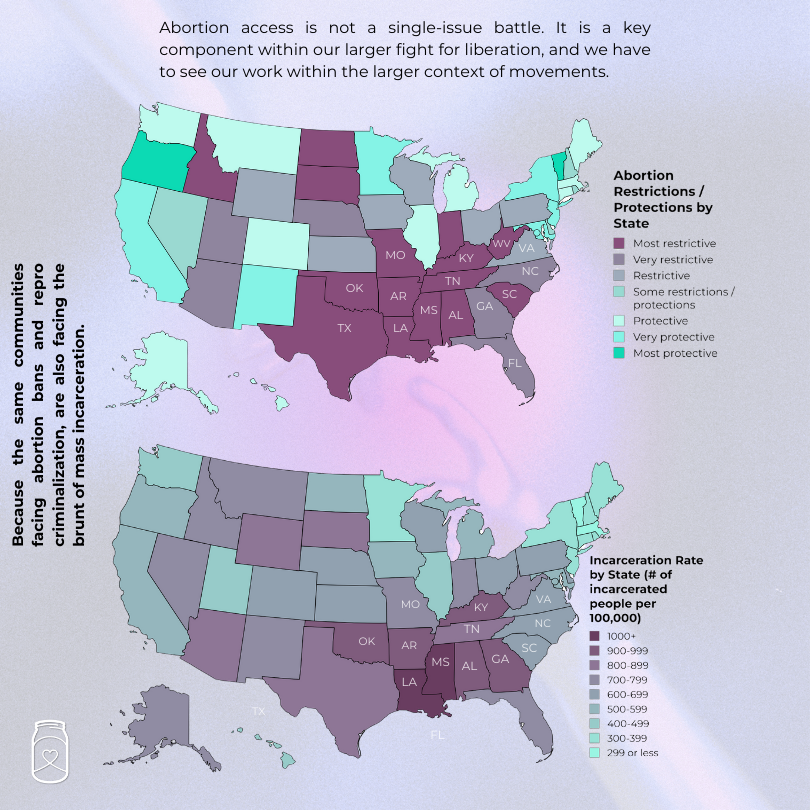
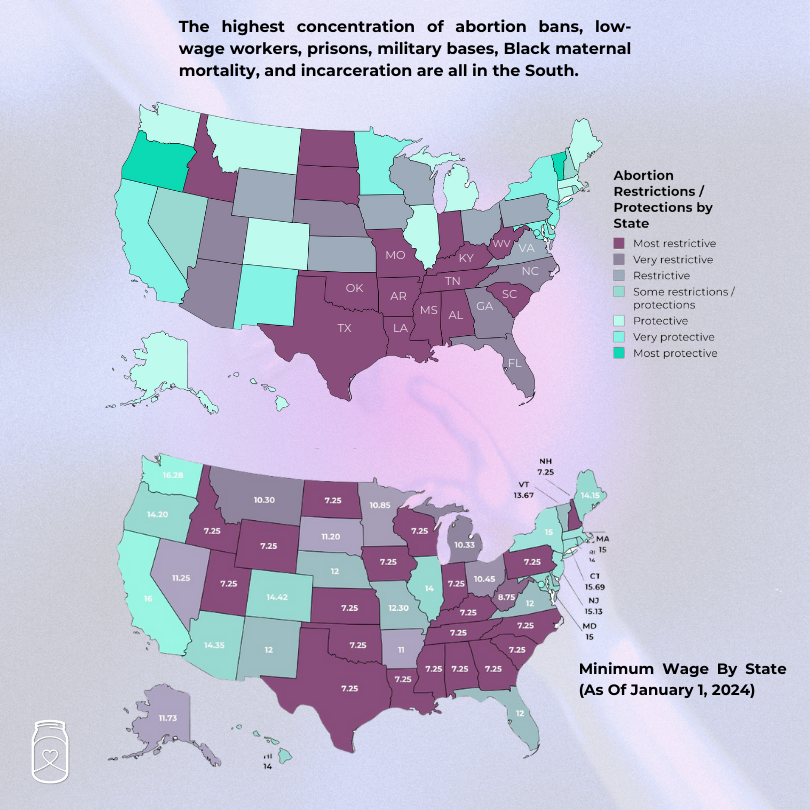
When we contrast the map showing the abortion restrictions nationwide with a map showing the concentration of incarceration rates nationwide, the ‘Black Belt’ is once again a common denominator. This overlap reflects how abortion access is not a single-issue that can be separated from our larger fight for liberation, because the same communities facing abortion bans and the criminalization of bodily autonomy and reproductive healthcare are also facing the brunt of mass incarceration and policing!
At the same time, we can see that the highest concentration of low-wage workers are also in the South. From enslavement to today, capitalists view the South as a region for the super-exploitation of Black workers, the suppression of wages, and limitations on travel and economic mobility. Class and poverty is the largest contributor to incarceration, second only to race, and shows that the economic situation of the South is connected to abortion access. Some even suggest that abortion bans are meant to force births of the most exploited people, to continue to have a large pool of low-wage workers.
In her 1949 article “An End To The Neglect Of The Problems Of the Negro Woman“, Activist Claudia Jones stated that Black women in the South endure “degradation and super-exploitation”, and says: “For the progressive women’s movement, the Negro woman, who combines in her status the worker, the Negro, and the woman, is the vital link to this heightened political consciousness.”
It’s important to note that in regions of the Midwest and Southwest, where there are large Indigenous and Latinx populations, we see the legacies of colonialism causing similar reproductive and interconnected oppression. On Native reservations and locations with large Indigenous populations, and similarly with areas of high Latinx and immigrant populations, we also see lower wages, higher incarceration and policing, abortion restrictions, and various systemic issues that stem from legacies of colonialism and imperialism.
By reflecting on these maps and the stories they tell, it becomes clear that the fight for abortion access is inextricably linked to the fight against racial and economic injustice and the history of racism and inequity in the South. These visualizations not only highlight the urgent need for equitable access to reproductive healthcare, but also call for a collective response to dismantle the structures that perpetuate injustice. At ARC-Southeast, we are committed to building power in the South, affirming bodily autonomy in the face of systemic injustice, and providing direct support to address disparities in reproductive healthcare access and help build a world where all Southerners have full access to care and support around their reproductive health decisions.
Want to help Southern abortion funds? Here’s how:
- – Donate to your local abortion fund. At ARC-Southeast, you can give a one-time donation, or select a recurring monthly gift to provide ongoing reliable assistance as the need dramatically increases.
- – Sign up for an abortion doula training session to learn how to provide emotional and physical support.
- – Advocate for systemic policies and structural solutions, like Medicaid coverage of abortion and unrestricted universal healthcare to address inequities at the root. We know that direct and mutual aid are only temporary solutions to deeply rooted capitalist crises, and we can’t have individual solutions for collective issues!
- – Support ARC-Southeast’s emergency contraception program, Plan B: Southeast, by registering your business or community space as a Plan B outpost!