By Lauren Kahre, MPH, ARC-Southeast volunteer
“Organized people beat big money everytime”
Reflections From Abortion Access Now Training in Philadelphia, PA
Last weekend, I had the opportunity to attend Abortion Access Now’s Eastern Regional Organizer Training in Philly! I was sponsored by Access Reproductive Care Southeast (ARC-Southeast) as a volunteer. It was an incredible weekend spent learning from organizers across the country, building connections across intersectional reproductive justice organizations, and getting to know the other volunteers (MonARChs) within ARC-Southeast.
Abortion Access Now (AAN) is a campaign of nine leading reproductive health, rights, and justice organizations working together to expand abortion access nationwide. The campaign’s mission is centered on a future where abortion is not just legal but accessible, affordable, and free from criminalization and stigma, lifted by three pillars:
1. Coverage: Eliminating cost barriers to abortion care
2. Restoring access to abortion care for all
3. Access without exception: Ensuring the right to abortion at any stage of pregnancy
Recap of The day
The training was held in a single conference room for the all-day event, a format that allowed people to actually meet one another and build the kind of familiarity needed to talk openly about their experiences in this space and the vulnerable side of this work.
The first portion of the day focused on language justice and why language rooted in inclusion is so vital to this work. To lay a broader foundation, AAN displayed a physical timeline of reproductive justice events, a reminder that this movement has been working toward its goals far longer than the fall of Roe v. Wade, and that Black and marginalized communities have historically been medically tested on and exploited within the specialty of obstetrics and gynecology.
Because this was a true organizer training, the majority of the day was spent on how to communicate mission and values, effective ways to talk about abortion, and what actually provides the activation energy to move someone from passively pro-choice to feeling empowered to take action. Hint: it’s not empirical data and a long list of statistics. Centering storytelling, and the real people who have faced adversity as a direct result of these policies, is one of the most effective ways to move the needle. That’s congruent with what I’ve observed throughout my advocacy career: legislators are more likely to support the pro-choice initiative if they can connect with it emotionally.
To put that into practice, we partnered up to role-play these conversations and learn how to navigate areas where we might be working against ourselves in how we communicate our movement. In one scenario, we played a concerned parent navigating abortion restrictions with their child but unsure how activism would be perceived by more conservative family members and neighbors. In another, we acted as a healthcare worker managing patients seeking care daily, witnessing the adverse impacts firsthand, but fearing workplace retaliation for speaking up. Working through those very real concerns drove home the nuance of what is inhibiting others taking visible action.
The other exercise I found central to an organizer’s work is understanding your own story. We reflected on what made each of us, as individuals, care about abortion access and organizing. Using a framework of Challenge (what was challenging), Choice (what choices did you have), and Outcome (what resulted) allowed us to draft a clear, efficient personal narrative. If you can’t effectively communicate your “why”, you risk losing the attention of the person you’re speaking with before you’ve even made the case for action. That groundwork then allowed us to expand outward: what is happening right now (like criminalization or laws) that require action, and what are the clear, concrete ways people can get involved at whatever level matches their ability and desire.
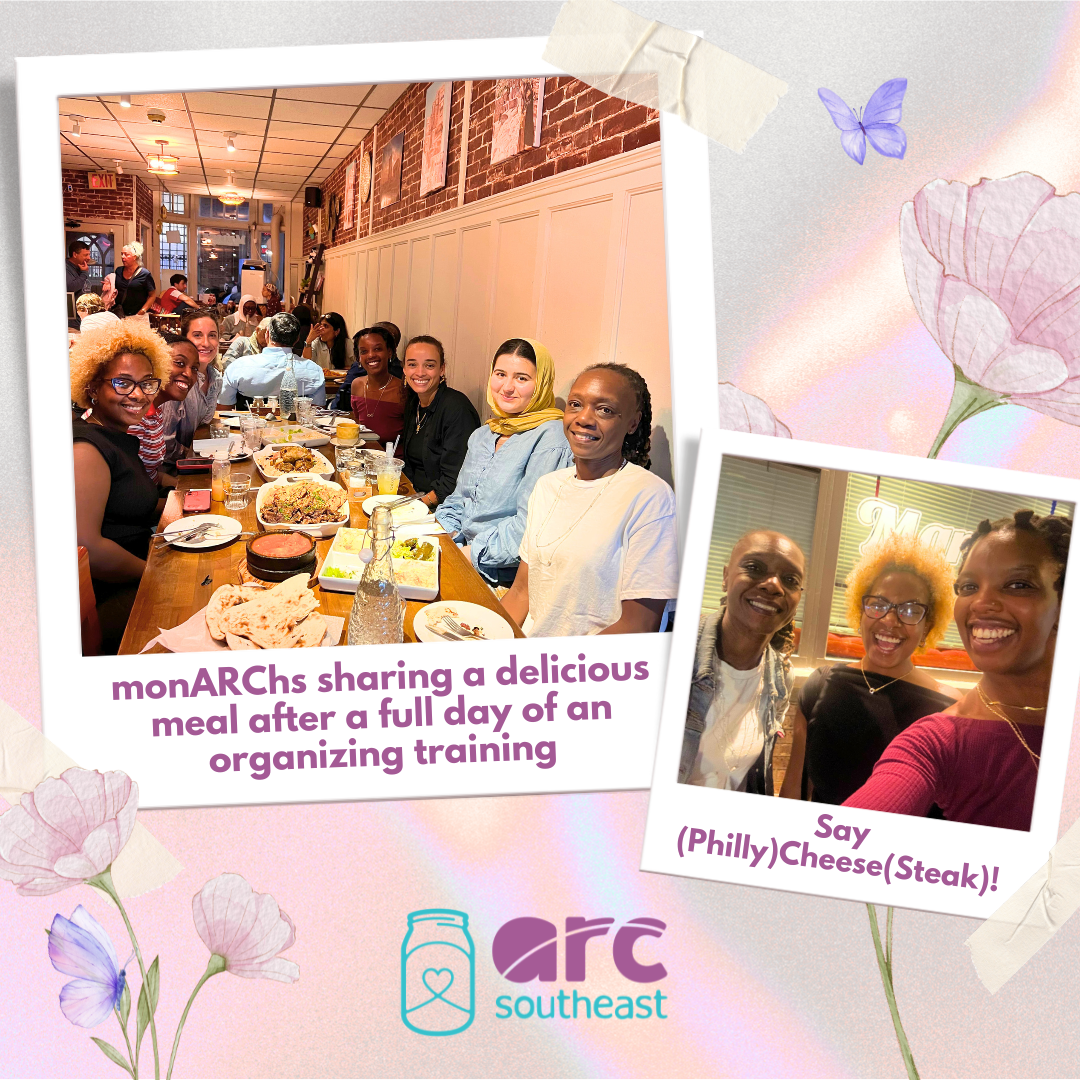
After the event, everyone attending as an ARC-Southeast volunteer, went out to dinner together. This was easily the highlight of my trip. Normally relegated to zoom squares on a screen, we were able to get to know each other in a real way. Every MonARCh brings different backgrounds, life experiences, and ideas to this space, which I view as the group’s biggest asset. Regardless of the different lenses we bring to this movement, we’re all solidly aligned on one thing: the people in the south deserve better, and self determination over their own bodies. Care shouldn’t depend on what state they live in.
How This Training Can Help the Communities ARC-Southeast Serves
AAN is a national campaign but the three pillars it organizes around (coverage, access, and care without exception) are very real in the South. They describe the daily reality for people calling ARC-Southeast’s healthline across Alabama, Florida, Georgia, Mississippi, South Carolina, and Tennessee, where cost, distance, and gestational limits force people to travel hundreds of miles out of state are the barriers standing between someone and their care. The training gave us national- level tools and language for communicating about these issues, and bringing those tools back to a region where the conditions are the most hostile and needs are most urgent.
This practice translated into real world action looks like reaching out to three people before the end of the month to check whether they’re registered to vote and are aware of their polling location. Ultimately, the weekend brought into focus how much I had been underestimating the power I hold locally, in my own sphere of influence. Could I knock on doors on my own street and speak about abortion restrictions? Probably. Changing the view of one person can be the start of a domino effect, creating real movement in how we collectively think about change.
What I took Away, Personally
Because I’ve been in this space for quite some time, much of the educational and intersectionality content was familiar to me. My experience is in policy and regulatory pathways so I spend much of my time looking into legislation and regulation. What really stayed with me was learning how many Americans genuinely believe in a right to abortion access without gestational limits. I watched counterparts from New York and New Jersey talk about how culturally accepted it was to be pro-choice in their region and how supported they feel in their communities.
Maybe it says more about me (at some point I need to unpack this), but in the South we don’t speak about abortion access in everyday conversation. Being in the Bible Belt, this topic is extremely taboo. Many people can’t even say the word abortion out loud. And I had forgotten that the majority of people share these same values; that bodily autonomy is a choice and people should have the right to make decisions for themselves. They, like me, just might not have a community to speak on it. ARC- Southeast and AAN are building a community one conversation, one training, and one organizer at a time, and I’m proud to be a part of it.
Lauren Kahre, MPH, is a public health professional and health policy analyst focused on reproductive health policy and advocacy at the state and federal level. She is a MonARCh volunteer with ARC-Southeast and writes Repro Justice and Advocacy for the South on Substack, covering policy developments, Southern organizing, and grassroots advocacy across the region.